WELCOME TO WORSHIP
Come, let us worship and bow down before our King and God.
This timeless invitation rests at the heart of our parish. At Worship, we warmly welcome you to step into the beauty of Orthodox prayer and experience a deep, meaningful relationship with God. Our community is built on reverence, love, and the rich traditions of the ancient Faith.
Whether you are seeking spiritual peace or exploring Orthodoxy for the first time, we invite you to join us for the Divine Liturgy and share in the living faith of our church.
DIMENSIONality OF WORSHIP
Worship is an experience which involved the entire Church. When each of us comes together for Worship, we do so as members of a Church which transcends the boundaries of society, of time, and of space. Although we gather at a particular moment and at a particular place, our actions reach beyond the parish, into the very Kingdom of God. We worship in the company of both the living and the departed faithful.
There are two dimensions to Orthodox Worship which are reflected throughout the many Services of the Church. First, Worship is a manifestation of God's presence and action in the midst of His people. It is God who gathers His scattered people together, and it is He who reveals Himself as we enter into His presence.
The Worship of the Orthodox Church very vividly expresses the truth that God dwells among His people and that we are created to share in His life.
Second, Worship is our corporate response of thanksgiving to the presence of God and a remembrance of His saving actions - especially the Life, Death, and Resurrection of Jesus Christ. Orthodox Worship is centered upon God. He has acted in history, and He continues to act through the Holy Spirit. We are mindful of His actions and we respond to His love with praise and thanksgiving. In so doing we come closer to God.
acts of Worship
Worship in the Orthodox Church is expressed in four principal ways:
The Holy Eucharist
The heart of our worship, where we give thanks and encounter Christ in communion. It is the most important worship experience of Orthodoxy.
The Sacraments
Sacred mysteries that mark God's active presence in the important events of our Christian lives, such as Baptism and Marriage.
Special Services & Blessings
Moments of prayer that invite and affirm God's grace and action in all the needs and tasks of our daily life.
The Daily Offices
Services of public prayer occurring throughout the day, including Matins and Vespers, keeping our community rooted in continuous prayer.
attributes
While Orthodox services are often elaborate, solemn, and lengthy, they nonetheless convey a deep and widespread sense of joy. This atmosphere reflects belief in Christ’s Resurrection and the transformation of humanity, and to foster participation and uplift the congregation, services are generally sung or chanted.
Worship is not limited to words alone. Alongside prayers, hymns, and scripture readings, the services include many ceremonies, gestures, and processions. The Church uses rich nonverbal symbols to signify God’s presence, and Orthodox worship engages the whole person - the mind, emotions, and senses.
Orthodox services follow a prescribed structure with a clear framework and design, which helps preserve their communal character and continuity with tradition. Some parts remain constant while others change according to feasts, seasons, or circumstances. This regulation by the Church emphasizes that worship is the act of the whole community, not the creation of an individual priest or congregation.
Another important purpose of worship is to teach the Faith. Because liturgy and doctrine are closely linked, worship both expresses belief and reinforces it; prayers, hymns, and liturgical actions therefore serve as key means of instruction. The regulated nature of services also helps safeguard the true Faith from error.
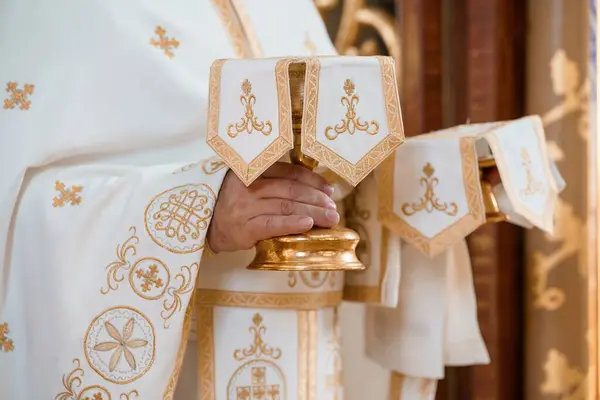
The Divine Liturgy and the sacraments are always presided over by ordained clergy. In a parish this is typically a priest acting on the bishop’s behalf, often assisted by a deacon; when the bishop is present he presides. The clergy’s vestments reflect their special calling to ministry and indicate their particular office.
Because worship represents the whole Church, the congregation is expected to take an active part; there are no private or silently said services. The faithful participate by singing, concluding prayers with “Amen,” responding to petitions, making the sign of the Cross, bowing, and receiving Holy Communion. Standing is the usual posture for prayer, with kneeling reserved for especially solemn moments such as the invocation of the Holy Spirit.
The litany is a prominent element of Orthodox services: a series of petitions led by the priest or deacon and answered by the people with responses such as “Lord, have mercy” or “Grant this, O Lord.” Litanies occur frequently and often help mark distinct sections of the service.
Orthodox worship is normally conducted in the language of the people rather than in a single official liturgical language. Services often use one or more languages to meet the needs of the congregation. Around the world, liturgies are celebrated in more than twenty languages, including Greek, Slavonic, Arabic, Albanian, Romanian, English, and Luganda.
904.404.2118
[email protected]
Coming Soon!
View on Map
Office Hours: Monday-Friday: 9AM-4PM
Liturgy: Sunday: 10AM
Bible Study: Sunday 3PM